12 September 2008

farm aid 2008

What's wrong with our farm system? It's unsustainable, unsupportive to family farmers, and unhealthy to us all. But for over 20 years, Willie Nelson, John Mellencamp, and Neil Young (and since 2001, Dave Matthews) have been striving to change that. As the face of Farm Aid, these musicians have seen their positive impact in the success of family farms, in the spread of the Good Food Movement, and through the development of grants that help farmers in need.

The concert
The Farm Aid concert, held next Saturday (9/20) in Mansfield, Massachusetts, is sold out this year. But you can still join the FarmYard fan club. If you join you get:

  • A Farmers Kick A$$ totebag
  • A chance to get special tickets to the FarmAid Concert
  • Year-round access to the members-only site with exclusive photos and video, including the 2008 concert webcast
  • 10% discount in the online store
  • Quarterly drawings for free autographed items like t-shirts and program books
Who benefits
One of the groups Farm Aid funds is FoodRoutes, a non-profit that provides support to organizations that aim to rebuild local, community-based food systems. One of their efforts is Buy Fresh, Buy Local, which introduces consumers to local produce and the farmers who provide it.

Meet the farmers who've benefited from Farm Aid.

Watch this important message from Neil Young

11 September 2008

green brooklyn all day event!

The Brooklyn Center for the Urban Environment is hosting an all day eco event that's free and open to the public next Thursday. After looking at the jam-packed schedule of workshops and talks on all things green, I think I'll be there for the full day. Here are the details:

The event

Green Brooklyn... Green City 2008
Thursday, September 18, 2008, 11:30am - 5:00pm
Brooklyn Borough Hall
209 Joralemon Street
Brooklyn, NY 11209


The full schedule

  • 12:00pm - 5:00pm
    Project ReUse: Reincarnate that Trash! Fun Zone
  • 12:00pm - 12:45pm
    Food Miles: An Inside Look at Food from Farm (or Factory) to Table
  • 12:00pm - 1:00pm
    The Real Greenbacks: Investing to Make a Difference
  • 12:30pm - 1:00pm
    Opening Address (featuring Sandi Franklin, Center for the Urban Environment • Marty Markowitz, Brooklyn Borough President • Antonia Yuille-Williams, Con Edison)
  • 1:00pm - 1:45pm
    Green Building: From Contracting to Certifications & CUE Case Study
  • 1:00pm - 1:45pm
    Breathe Easy: A How-To for Creating a Non-Toxic Home Environment
  • 1:00pm - 2:30pm
    Special Film Screening and Discussion: King Corn
  • 3:00pm - 3:45pm
    Solar Your Building
  • 2:45pm - 3:45pm
    Sustainability in the Nonprofit Sector: A Leader's Forum
  • 4:00pm - 4:45pm
    Navigating NYC: From Pedicabs to Green Car Services
  • 4:00pm - 5:00pm
    How Big is Your Footprint: Free Professional Development for Teachers
Read more about the event.

Check out the King Corn trailer:

great remake

I'm always trying to find new uses for trash. I've made cereal boxes into magazine racks. And I've got a pile of plastic from food packaging and coffee top lids that I'm looking to repurpose.

Well, now there's a place that can help me do just that. RePlayGround knows how to give garbage a new life, and they'll show you how, too.

With RePlayGround's help bottlecaps become magnets, old glasses become picture frames, and umbrellas become skirts. They'll even come to your birthday party or other special event for on-site, hands-on trash transformations. Plus they've got kits and project books to make it easy for anyone to make lamps, transform clothing, or turn garbage into games.

They also take on design projects for companies -- just give 'em your office trash and they'll make some great gift-worthy items for employees or clients.


See how it's done:


Find out if any stores near you sell their remade stuff.

[RePlayGround via Ideal Bite]

10 September 2008

abstract impact


Our impact on the planet is profound. These are NASA images (courtesy of NASA via Environmental Graffiti) of Garden City, Kansas croplands (above) and Brazilian deforestation (below). Check out more amazing images of earth from 400 miles above here.

09 September 2008

a message


[My friend Anne took this last week when we were in the park.]

08 September 2008

exploring, gathering

With no immediate intentions other than eating our lunch, my bf and I went to Prospect Park yesterday afternoon. The weather was amazing -- sunny but not too hot, perfectly comfortable in the shade -- it was like the storm of Saturday hadn't happened.

After polishing off some rigatoni (with heirloom tomatoes, goat gouda, basil, chives, and fresh chili pepper, yum!) we sat for a bit. We noticed an unusual amount of little children in the park, as if the rain had sprouted them like mushrooms out of the ground. We watched as dogs pranced by, commenting on their coats and gaits, and guessing their breeds, one of our favorite past times.

Then we got up and went over to dog beach for some more canine commentary. Despite recent reports of contamination by rat excrement (more here and here), the little section of the pond that's cordoned off for doggy frolicking was jam packed with puppies.

[Image: Lane Johnson, AM New York]


Aside from the pups, some rose hips poking out from behind a fence caught our attention. Knowing exactly what they were by their leaves, thorns, and telltale fuzzy tops, we picked a bunch.
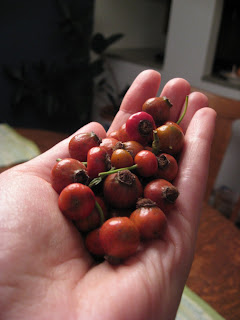
[The rosehips we picked]


This little discovery-in-plain-sight sparked my newfound fire for finding wild edibles. So we headed into "the woods." Right on cue, as we passed to the right of the pond, we saw a cute little rat feasting on some hawthorne or some other apple-like fruit. Another passerby labeled him "local fauna."

We took a trail we usually don't go down, towards the Center Drive and Nethermead. We walked along the drive, to the southwest, eyes peeled to the ground. Burdock, pokeweed (poisonous at this time of year), jewelweed, and goldenrod -- we identified them and walked on by. Along the drive is a bridle path, and we ended up walking in it (paying heed to horsey landmines). Then we spotted a seemingly less traveled mulch- and leaf-covered path. As close as we were to the road (which generally isn't open to car traffic), I felt strangely transported. It was so serene, apart from the rustling of leaves by robins, squirrels, and a couple of speedy chipmunks.

To the right of this path ran a chainlink fence which I didn't think much of until we came across this sign (on the other side of the fence):

[Image: Noelle D'Arrigo, Brooklyn Paper]


I thought I remembered hearing about a cemetery in the park where Montgomery Clift was buried. For some odd reason, I forgot about this fascinating info. The Quaker Friends Cemetery isn't open to the public, except on rare special occasions or on volunteer clean-up days. But I just love knowing it's there, the little bit of it we could see from the trail. (Learn more about the cemetery.)


[Image: Rikomatic]


We continued up the trail, now heading north-northwest. Caught another view of the cemetery (though not as revealing as the one above) and continued on.

At the bottom of the trail we collected spicebush berries, more to add to last week's collection which have been drying on the countertop (I just put the dried ones in the fridge).


[Fresh vs week-old picked spicebush berries]


Under the spicebush we saw what at first we thought were potatoes, then pears. After further inspection we realized they were some kind of nut. We looked up and realized that high up in the trees there were many more (Please don't fall on my head!). After an inquiry to my go-to foraging expert, Leda Meredith, I learned these were probably horse chestnuts, and therefore not edible.

[Most likely poisonous horse chestnuts]


At this point we were by the baseball fields, behind a big pile of mulch. We walked back to more familiar territory and found some more tree nuts, this time (potentially) edible ones, black walnut.


[Hopefully black walnut... gotta crack it open to find out]

I've lived here for over 5 years and have been to this park countless times, yet there are still new things to discover. (I'm sure the woman who writes A Year in the Park would whole-heartedly agree.) I just have to remember to take a step off the usual path to find them.

world of good (shopping)

When I spend my hard-earned dough I'd like to know where it's going. Who is it benefiting (or harming)? What kinds of resources were used? Is it really worth the price (in terms of labor, effort, materials, etc)?

So in recent years, I've become really selective about where I shop. As I've said before, I avoid the big box and big name retailers (whenever possible) in favor of local, indie biz. Think Etsy vs Banana Republic, eBay vs Crate and Barrel. Of course there are times when it's really difficult to completely ignore the big boys, like when you need a paper towel holder or new toilet seat.

Thankfully it's getting easier and easier to find alternative sources for goods. Like the new responsible marketplace by eBay, World of Good. They've got a pretty big range of fair trade and/or eco-friendly stuff, from clothing and jewelry to furniture and toys. What's really great is that they break it down in terms of the impact your purchase has. They call this a Goodprint and these are the categories: people positive, eco positive, animal friendly, and supports a cause.

It's feel-good shopping, certified by third parties with their Trustology verification system. Many of their verifiers and sellers have been in the fair trade game for years, including Co-op America and Ten Thousand Villages.

Here's a random selection of fun things you can get from World of Good:

PeaceKeeper Nail Polish
Proceeds go to people positive charities


Telephone Wire Bracelet
Eco-friendly repurposed wire, benefits South African artisans

Baby Llama Toy
Benefits Peruvian artisans, made with energy conservation in mind


Where does your hard-earned dough go?

feel-good farming


EcoSalon reports on sustainable family-run farms, specifically 3rd generation Tramar Farms in Iowa.

They clearly state that they are stewards of the land (and they intend to leave it better than they found it) and that their animals are to be raised ethically and humanely, with access to fresh air, green grass and clean water.

Contrast that to a typical factory farm, which treat animals like
unfeeling meat-producing machines, routinely use chemicals and cruelty, and leave the surrounding lands destroyed by huge polluting pools of manure.

It may cost a little more to get your meat, milk and eggs from a healthy family farm, but you are what you eat, and your money supports whatever you spend it on. What’s it worth to you?

I couldn't have said it better myself.

07 September 2008

06 September 2008

where is everybody?

Today's farmer's market run was rather unsuccessful. Hanna (downgraded from hurricane to tropical storm) kept most of the farmers away. I don't blame them, it looks pretty menacing out there.

We wanted to get eggs from Flying Pig Farm. They had none, in fact, nobody had them. The mushroom guy wasn't there. Our favorite meat suppliers weren't either. We grabbed what we could -- some squash, radishes, a couple heirloom tomatoes, micro-greens, and bread. Looks like we'll have to rely on the supermarket a little more heavily this week.

The looming storm also kept us from going to a friend's barbecue, her house a little over an hour north. It's really coming down now. I think we made the right choice.

timbuk2 sale

If you're in the market for a new bag, Timbuk2 (known for their durable messenger bags) is having a big sale. Their eco-friendly "grown" line is made from hemp and recycled PET (plastic). All of their bags -- even the conventional ones -- are PVC-free.

Wiki Laptop Case
Was $55, Now $35.75

Classic Messenger (x-small)
Was $110, Now $55

Classic Messenger (small)
Was $130, Now $84.50

Classic Cargo Tote
Was $100, Now $65


you don't need green to be green

The other day, a friend of mine brought up the common misconception that in order to be eco-friendly, one needs money. There's really just one thing that I practice to live a sustainable lifestyle: mindfulness. And I think mindfulness in this case can be broken down into 3 actions: a) plan ahead, b) consume less, and c) do your research. Here are a few guidelines that I live by...


Plan ahead
(or, be prepared)

1. BYOE: Bring your own everything, everywhere

  • This includes, but isn't limited to: reusable utensils, reusable drinking containers, shopping bags, and lunch
  • You don't have to go out and buy special portable utensils, just borrow some from home
  • Buying a $20 reusable water bottle and filling it at home or at a water fountain is a heck of a lot cheaper than buying a $1 bottle everyday (or even every week if you're one of those people who refill disposable bottles).
  • Same goes for coffee and tea -- brew it at home or at the office and drink it in a mug
  • Your shopping bags don't have to be anything fancy, most of our bags were giveaway totes. Even just reusing plastic grocery bags will keep the garbage out of the waste stream for a little longer
2. Plan meals
  • If you know what you're going to eat ahead of time, you'll buy only what you need
  • If you go to the supermarket on a full stomach, you'll be less likely to buy stuff you don't need
  • Plus you'll keep food out of the landfill where it produces methane, a greenhouse gas that contributes to climate change (according to the EPA, methane is 20 times more damaging to the environment than carbon dioxide)
3. If you can grow it yourself, do
  • You'll save money, fuel, and carbon output
  • Plus, you'll know where your food is coming from
  • If you don't have your own garden, try a community garden
4. Compost if you can
  • You'll keep food out of the landfill (see item number 2) and create rich food for your vegetable garden
  • Learn how here
5. Keep your car maintained, and hypermile
  • If you have a car, keep it clean and the tires full -- both of these simple things can help save gas
  • Hypermiling is a tactic people use to save fuel. Find out more here

Consume less, live more

1. Buy less stuff

  • Especially new stuff, or stuff made overseas
  • I promise, life will be just as fulfilling without that 5th pair of sneakers or giant flatscreen TV or beauty product, or whatever it is you're thinking of buying. I know, I'm a recovering shoe addict and impulse buyer myself
  • Of course there are times when you need stuff, or maybe you like collecting stuff as a hobby. Just use your judgment and buy used whenever you can. Shop at eBay, craigslist, or FreeCycle (this one's free!)
2. Eat less meat
  • It's pricey, has a huge impact on the planet, and isn't all that healthy in large quantities
  • Greens and grains are healthier and generally cost a lot less (they also taste good once you get used to them -- especially the fresh ones)
3. Eat and drink less junk
  • Junk food is highly processed, so a lot of energy and resources go into making it
  • And it's full of bad stuff
  • Trust me, you'll feel better in the morning if you don't reach for that jumbo bag of Doritos and 32 oz Gatorade. It may seem cheap and tasty now, but just wait 'til you get those medical bills in 20 years
4. Think before you...
  • Print or copy: Can you read it on the computer? Can you copy double-sided?
  • Purchase: See number 1
  • Toss: Can that thing you're about to throw away be reused or recycled? Maybe somebody else could use it if you don't want it anymore. If it's toxic, dispose of it properly (find out how at Earth 911)
  • Drive: Can you walk, bike, or take public transportation instead?
5. Use less water and energy
  • You'll end up saving money if you conserve
  • Find 100 ways to save water, specific to your region, here
  • See my tips for summer energy saving

Do your research
(Find out where stuff comes from and what it's made of. Here are a few things I've learned...)

1. Health and hygiene
  • Ingredients to avoid: parabens (methyl-, ethyl-, propyl-, butyl-), synthetic fragrance, petrolatum, diethanolamine (DEA), triethanolamine (TEA), sodium laurel sulfate (read more about ingredients to avoid)
  • Not sure if your products are harmful? Check the Cosmetics Database

2. Cleaning products
  • You can make your own non-toxic cleaning supplies with inexpensive household products, like white vinegar, washing soda, hydrogen peroxide, lemon, and oil (learn more at The Green Guide)
  • Use rags (old t-shirts and towels work well) instead of paper towels
3. Food
  • Eat whole, minimally processed foods
  • Read the label -- avoid ingredients that you can't pronounce or that have many qualifiers, like high-fructose corn syrup or enriched bleached white flour
4. Furniture and homegoods
  • Avoid furniture and paint made with off-gassing volatile organic compounds (VOCs), chemicals like formaldehyde
  • Skip products made with PVC, like shower curtain liners -- opt for cloth instead
  • Choose napkins, paper towels, toilet paper, and tissues made from paper, not from trees. Go with these brands that are both high quality and environmentally friendly (Marcal, Seventh Generation, Green Forest). AVOID: Bounty, Scott, Viva, Kleenex, Puffs, Charmin, Cottonelle (they're all made from trees!)
  • Buy in bulk to save money and packaging

Keep it simple...

Another simple way to live green is to heed the 3 Rs: reduce consumption, reuse what you can, and recycle what you can't.

Find more eco on a budget tips at The Budget Ecoist

Why bother?

05 September 2008

what the HFCS?!!!


Oh sweet propaganda. I love the qualification of "it's fine in moderation." Yeah, so is cyanide. Problem is, high-fructose corn syrup (HFCS) is in a lot of foods which you wouldn't expect. It's not just sugary drinks and ice pops. HFCS is in most commercially available bread, even "whole wheat" and "multi-grain" varieties. It's in that all-American condiment, ketchup.

HFCS isn't just bad for your health, it's terribly unsustainable:

Most corn is grown as a monoculture, meaning that the land is used solely for corn, not rotated among crops. This maximizes yields, but at a price: It depletes soil nutrients, requiring more pesticides and fertilizer while weakening topsoil.

"The environmental footprint of HFCS is deep and wide," writes [Michael] Pollan, a prominent critic of industrial agriculture. "Look no farther than the dead zone in the Gulf [of Mexico], an area the size of New Jersey where virtually nothing will live because it has been starved of oxygen by the fertilizer runoff coming down the Mississippi from the Corn Belt. Then there is the atrazine in the water in farm country -- a nasty herbicide that, at concentrations as little as 0.1 part per billion, has been shown to turn male frogs into hermaphrodites."
Plus...
Milling and chemically altering corn to form high-fructose corn syrup also is energy-intensive. That's not to say that corn is evil and other foods aren't; all crops require energy to grow and transport. What makes corn a target is that federal subsidies -- and tariffs on imported sugar -- keep prices low, paving the way for widespread use of high-fructose corn syrup and, in the process, keeping the American palate accustomed to the sweetness it provides.
Read the rest of the Washington Post article here.

Oh, and it's not surprising, the commercial was brought to you by the Corn Refiners Association.