
One of the great things about Etsy, crafty online marketplace, is that you get to deal directly with the artists who craft their wares. Many one-of-a-kind or limited edition items -- arts, crafts, jewelry, apparel, letterpress, even food -- are waiting to find a good home. You can also choose to buy locally, from artisans in your area.
Here's a little roundup of some of the eco-friendly goods available on Etsy.
Dollparts and Candy
Remade, Japanese-inspired clothing -- if you get one of their special garments, you can probably guarantee that you won't see anyone else wearing it.
Go West Prairie Cowgirl Shirt
$22
Superscoop Icecream Denim Skirt
$28
Toggle
Cool chain knit necklaces made from New Zealand wool (so it does have to travel all the way from Auckland, if you're not in that neck of the woods) are a more eco-friendly alternative to metal chains. As Esther and Shelley of Toggle say: Enjoy some gilt without the guilt!
Soft Rocks Woollen Chain in Black with Jewels
$78
Soft Rocks Woollen Chunky Chain in Deep Purple
$58
Soft Rocks Chunky Chain in Silver
$40
Greenstarstudio
Danamarie Hosler is known for her knitimals, unique creatures made from various textiles -- wool, yarn, felt, &c. But I especially like these felt masks, just in time for Halloween (of course the kids will want to wear them all-year round... I see plenty of little boys dressed up like Batman in the middle of the summer around here).
The masks are hand-stitched, adorable, and you can get one for your favorite little monster for only $12 each. (They fit most adults, too!)
Red bird knitimal mask
$12
Blue and yellow knitimal mask
$12
VKnO
One of VKnO's specialties is her "Windows of the Past - Pop Art Pendants." As she puts it in her profile: A unique and eye catching piece of art for you neck. The one-of-a-kind pendants are made from recycled aluminum cans and vintage magazine or newspaper clippings. Pretty clever stuff.
Just like the sun
$14.50
Who said it's a dog's life
$14.50
Map Greenwich London (of course I love this one, it's a map!)
$14.50
naturaleza al descubierto
The gorgeous natural wood and plant materials in the jewelry by Marlon and Amy Solano are sustainably collected in Nicaragua. They accept custom orders, so if you're looking for a unique gift or wedding ring, naturaleza's beautiful jewelry could be for you.
La Malinche
organic seed earrings
$20
Asi
nambaro wood ring with sterling silver inlay and band
$82
Ojo
coyol ring with tagua and jadeita inlay
$86
23 September 2008
eco etsy finds


22 September 2008
fin, finito, bye bye fishies
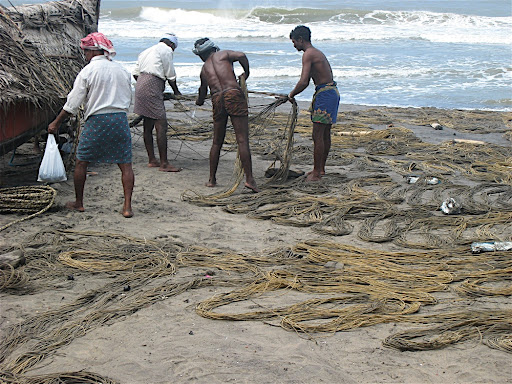
The oceans are being depleted of their onetime abundance. Overfishing is something we can all help stop if we want to save fish from extinction. There is a sobering article in GOOD magazine about the imminent global collapse of fishing. It is a must-read for anyone who eats fish. Some eye-opening highlights:
The end of fishing = global food (and economic) crisis
The demise of commercial fishing is beyond the limits of even our darkest environmental imaginations. And yet the evidence of the ocean’s diminishment is everywhere. Leaving aside the legitimate concerns of conservationists, the possibility of a broad fish collapse is harrowing for other reasons. At a time when we are mired in a global food crisis, nearly 1.5 billion people depend upon the sea as a source of food or income. The destabilizing effect of such a collapse would be tremendous, bringing communities and countries into conflict over a resource we once considered boundless. It is fair to say that the endgame has begun.
Government support for an unsustainable industry
Many experts think that governments have been too kind to the fishing industry. The European Union, China, Japan, and the United States spend as much as $20 billion a year to subsidize a $90 billion industry. The number of industrial-sized fishing boats in the world, which the U.N. estimates at 1.3 million, will have to be reduced by more than a third to reach sustainable levels of fishing (and some conservation organizations put the number at closer to half).
Overfishing isn't the only problem, but it's the easiest to fix
We have imperiled what is perhaps the last wilderness on earth, for the simplest reason: We believed it was so vast it couldn’t be harmed. The signs of our folly are now too numerous to ignore. Massive, swirling gyres of plastic have formed in the North Pacific, as have toxic dead zones in the Gulf of Mexico, the Black Sea, the Baltic Sea, and dozens more places. Coastal pollution and construction is destroying critical wetland habitats worldwide. And the ocean itself is warming, a development that will have consequences we can hardly imagine. Amid these challenges, overfishing represents the most immediate threat and possibly the easiest problem to remedy.
We are all responsible
Because of our role as consumers, we’re no less culpable than fishermen for the state of the oceans. Global seafood consumption has doubled since 1973 and, just as its health benefits are becoming known, it seems clear that we will have to eat less fish, and that the fish we do eat will have to be smaller and lower on the food chain, where the effects of fishing are less pernicious. A cod caught by a bottom trawler carries with it a different set of environmental implications than a cod caught by a hook and line—and we ought to recognize and pay for the difference. And we would do well to contemplate, too, why it is that we become indignant at the thought of a world without wolves or elephants, yet stand idly by as bluefin tuna, for instance, are hunted into obsolescence. This animal, as grand as any we know, can live for 30 years, weigh as much as 1,200 pounds, and cross thousands of miles of ocean in a single year.
Please read the whole article.
You can do something!
- Follow the Monterey Bay Aquarium Seafood Watch Guide. They have a free downloadable (or mail order) pocket guide you can take with you to restaurants.
--Some common fish to avoid: Atlantic halibut, Atlantic cod, Atlantic salmon, flounder, sole, monkfish, Chilean sea bass, trawl-caught haddock, skate* - Tell your favorite restaurant or fishmonger to offer sustainable seafood
- Help the Director of the National Marine Fisheries Service make the right decision about shaping new commercial fishing regulations

brooklyn harvest

It's the first day of Fall and it's already feeling a bit cooler. The kids are back in school, people are already donning boots and sweaters, and some are gearing up for harvest.
For those of us in the city, no upstate trip is required to enjoy some good ol' fashion pumpkin picking and harvest feasting. In Brooklyn, there are two harvest festivals next month.
The Gowanus Harvest Festival
Saturday, October 11 @ The Yard
11am-9pm
Advanced tickets $10
Day of Show $12
Children under 5 Free
Brooklyn! Fall! Brews! Bounty! Yes, its that time of year again. The Yard is once again hosting a fall-themed celebration of Gowanus proportions.Last year was an incredible success – over 1,000 people joined us at the banks of the canal to enjoy farm fresh food, live music, local vendors, pumpkin carving contests, pony rides, delicious brews and other triumphs of sustainable urban living.
This year, proceeds from the Gowanus Harvest Festival will be donated to Just Food.
So join us and enjoy the wonders of Autumn on Brooklyn’s most …charismatic… waterfront.
Red Hook Harvest Festival
Saturday, October 18 @ Added Value Farm
Annual festival featuring foods from local restaurants, live music and performances, kids' activities, pumpkin patch, raffle & contests, farmers' market, farm tours.
Join several thousand New Yorkers, young and old as we gather together to educate, motivate, inspire and create a more sustainable future for Red Hook and all of New York.What is a harvest festival?
Explore the Red Hook Community Farm, New York City’s largest urban agricultural project and take a tour of the facility led by a member of Added Value’s youth leadership team. Purchase fresh fruits and vegetables from the Farm, RonnyBrook Dairy, Red Jacket Orchard, and Wilklow Family Orchards.
Enjoy great local, seasonal fair produced by some of the finest restaurants in the City including The Good Fork, Restaurant ICI, Tini, Baked, and Rice. Press New York State apples into fresh cider, check out the livestock, pick a pumpkin and enter into your art into the craving competition, or pickle some string beans with Classie Parker.
Explore the practicality of solar power, harvesting the wind, collecting rain water and making your own bio-fuel by learning from greening organizations such as: Tri-State Bio Diesel, The Cloud Institute, Community Wind, The Water Resources Group, Solar One, and the Brooklyn Greenway, Just Food.
Experience the harvest near you
2 orgs that offer abundance to those in need
- City Harvest
- Feeding America (formerly America's Second Harvest)
[Event info via Brooklyn Based]
welcome back, nau!
While they're not open for business unusual -- as they put it on their site -- until mid-October, my favorite eco-friendly activewear company has revealed some of their latest designs. I'm so excited for the return of Nau!
I believe they had designed some of these items before they closed shop earlier this year. Apparently, and thankfully, they had fans within their own industry that helped launch Nau 2.0. West Coast apparel company Horny Toad picked up Nau in June. Read more about the acquisition here.
Check out more of the Fall 2008 sneak preview designs here.
[via Treehugger]
foraging with the wildman
We gathered a small feast of wild edibles this past Saturday in Prospect Park on our latest foraging tour -- this time with "Wildman" Steve Brill. Both the content of his tour and his conduct explain the alias.
Before he even collected our $15 "suggested donation," he was hocking his wares (field guides, a cookbook, magnifying lenses). From the wadded up piece of paper he pulled from his cargo pants' pocket, he took attendance. He phoned the stragglers.
He put his daughter, the aptly named Violet, in the care of over 20 patient tour participants as he brought his merchandise back to the car. "Has anyone seen my daughter?" he uttered more than once as we waited in Grand Army Plaza.
After about 25 minutes, he announced the start of the tour. He played us the "Brill-a-phone" -- a pseudo wind instrument created by clapping his hands in front of his open, hollowed-out mouth (somewhat akin to blowing on the top of an empty bottle).
Wildman Steve Brill
Despite The Wildman's idiosyncrasies, it was an enjoyable day. The sun shone warmly, but the shade provided relief. I learned more about the edible plants around me. Sampled some new wild food and took home enough to be able to enhance some meals.
The root vegetable of the burdock plant, known as "gobo" in Japanese cuisine, will be a good addition to some vegetable soup I'm making. As will the goutweed or bishop's elder, with it's mostly celery, partly parsley flavor.
Root of burdock (Arctium) on the plant
Root of burdock (Arctium) on my table
Goutweed or bishop's elder (Aegopodium podagraria)
I'll make a "lemonade" with the staghorn sumac I picked (with the help of a tall tour mate).
Staghorn sumac (Rhus typhina)
I pulled a sassafras sapling from the ground -- its root makes a nice tea.
Pulling sassafras
Sassafras root
The wood sorrel (Oxalis), bright and lemony, will be a tasty addition to a salad or a sandwich. I didn't pick enough of it, but the lamb's quarters (Chenopodium album) would be a nice salad green or spinach alternative (it's high in vitamins A and C, calcium, folate, fiber, and protein).
I can make a dressing with grated garlic mustard root.
Root of garlic mustard (Alliaria petiolata)
We sampled some hackberries -- the dried, brown ones taste a bit like the candy coating of an M&M. We also ate some foxtail grass seeds. Just gently twist the head of the grass over your palm for a mild little treat. A word of warning for pet owners: I've read that the seeds are toxic for dogs.
Hackberries (Celtis)
Foxtail grass (Alopecurus L.)
I tried a bit of black walnut, and my boyfriend and I came back the next day to collect some. We only found a couple, but the tree is full of them. Maybe in a week they'll have fallen. When you do collect them, be sure to remove the husk before bringing them home -- they tend to become infested with bugs.
Lots of nuts up in that black walnut tree (Juglans nigra)
Black walnut husks
A Monarch butterfly we spied at the end of the tour
While we did collect quite a few wild edibles, I was happy to see many farmer's market stands still open so late in the afternoon. My dogs were barking at this point, so my boyfriend gathered a few things while I sat on the curb. When we got home, we used the field garlic in an heirloom tomato salad.
Field garlic (Allium oleraceum)
Grand Army Plaza greenmarket
Related reading
The Wild Vegetarian Cookbook by "Wildman" Steve Brill
Identifying and Harvesting Edible and Medicinal Plants in Wild (and Not So Wild) Places by Steve Brill
Take a tour with the Wildman
Related posts
exploring, gathering
yesterday's brooklyn foraging tour [with Leda Meredith]
stalking the wild asparagus
21 September 2008
heavy stuff about what we eat

I just read a great post from Think Simple Now about the health, ethical, and environmental implications of our animal-based diet (including dairy products).
Read the whole story.When I became a vegetarian, my main motive was for health, but as I dug deeper into what was happening in animal agriculture, the truth was heart breaking. I was in distress after learning about it, and thinking about it still makes me sad.
About 10 billion land animals are killed each year for food in the US, according to the USDA; this includes 35 million cattle, 100 million pigs, 300 million turkeys, and 9.5 billion chickens. That is more than 1 million animals killed every hour. Animal agriculture is a $100 billion a year industry, with even more powerful lobbying interest than the oil and pharmaceutical lobbies (exposed by Eric Schlosser’s Fast Food Nation).
At such a scale and with efforts to drive down cost, how do you think animals are treated? The answer: the most time efficient way possible to minimize cost. With that in mind, animals are skinned alive, limps ripped out of them, beaks or testicles chopped off without pain relief.
20 September 2008
goats are great (lawnmowers)
I have a thing for goats, as some of you might already know. If I had a yard and it were legal in this city, I'd have a goat. So naturally I was excited to see this Nightline feature on goats as lawnmowers in LA. Check it out:
19 September 2008
delicious and nutritious food bar
Have you ever tried a Lärabar? I was looking for a little something sweet yesterday, but I didn't want it to be full of crap. So one by one, I turned over the 'healthy' candy-like energy bars, reading the contents and nutritional info. When I got to the Lärabar, I couldn't believe it. I actually had to read the ingredients list 3 times. Get this -- there are only 3 ingredients in the Peanut Butter Cookie flavor: dates, peanuts, salt. That's it. Naturally sweet and savory, 5 grams of protein, 4 grams of fiber, 1.7 ounces of delicious.
Lärabar also has a line of Jocolat (or chocolate) bars that I'd like to try.
I don't think they're organic, but they do claim no genetically modified ingredients. And while the umlauts in the name suggest they come from some Scandinavian or Germanic land, the Lärabar is made right here in the USA by Humm Foods.
You can get yourself a whole case, but you might want to try one first.
It looks kind of like headcheese here, but I swear it's yummy!
there are whales out there!

Right here in NYC, not far from the isle of Manhattan, whales are dodging cargo ships and singing their melancholy songs. It's a first for the city, not their presence, but the recording of their sounds -- of humpback, northern right, and fin whales.
This is an exciting time for New Yorkers. Just think, just miles from the Statue of Liberty, the Empire State Building, Carnegie Hall and Times Square, the great whales are singing," says Chris Clark, the Director of the Bioacoustics Research Program at the Cornell Lab of Ornithology. "These are some of the largest and rarest animals on this planet trying to make a living just a few miles from New York's shores. It just goes to show us that there are many important and wonderful discoveries to be made about the living world right here, right in our back yards.Read more at Science Daily.
18 September 2008
brooklyn green event recap, part 3: the film
This is part 3 of my recap of Green Brooklyn 2008 (scroll down for parts 1 and 2).
There was a small turnout for this screening, but I think it had an impact on everyone there.
King Corn
Everyone should see this movie. For real. I read a lot of stuff about commodity corn in The Omnivore's Dilemma. But seeing it on the screen, hearing the farmers talk about how they are producing "crap" (and not giving a damn), seeing a small town in Iowa transform from being centered around family farms to industrialized agriculture -- it's frightening stuff. It gets bigger and bigger, a monoculture that's not even edible by humans without being highly processed, that's mostly feed for animals in factory farms.
The main goal and outcome of this agricultural giant: drastically reduce food prices for consumers by flooding the market with corn (thanks in great part to Earl Butz, Secretary of Agriculture in the 1970s). What it's helped create: pollution, sick animals in confined feed operations, and an obesity and diabetes epidemic. It's a moral, economic, and environmental issue worthy of everyone's attention.
Ah, what am I going on about -- just watch the movie!
Oh and...
I think we can all make conscious decisions to change the landscape for the better. Choose foods and drinks without high fructose corn syrup, eat grass-fed and humanely raised beef (or go vegetarian), support your local farmers by visiting farmer's markets. It may cost a little more now, but what you're paying for is a healthy future for yourself and for future generations.
Related posts
What the HCFS?!!!
My own private omnivore's dilemma
green brooklyn event recap, part 2: panel discussions
This is part 2 of my recap of Green Brooklyn 2008 (scroll down for part 1). I attended part of two different panel discussions, one on green investing and the other on solar panel installation.
Panel Discussions
The Real Greenbacks: Investing to Make a Difference
Speakers
- Heather Langsner, Innovest Group
- Lily Scott, Veris Wealth Partners
- Louis Berger and Subir Grewal, UBS Securities
- Richard Feldmann, Ventura Wealth Management
Takeaway
I have to admit, my eyes glaze over when a prospectus is put in front of me. Financial talk goes in one ear and out the other. Which is why I had to attend this discussion. I've been thinking a lot about where our investments are going -- to major polluters and irresponsible corporations (oil companies, big agrobiz, tobacco, &c.). I'd love to invest responsibly, with my conscience, I just need some education.
Sustainable investing goes beyond socially responsible investing (SRI), which traditionally excludes the worst public offenders from the equation. Sustainable investing rewards those public companies with sustainable practices and principles. SRI, according to Lily Scott from Veris Wealth Partners, also apparently rewards investors with a greater return on investment than the S&P 500 (11.67% vs 10.2%). It makes sense if you think about it -- sustainable company = sustainable growth = sustainable return (it's not math, but it makes sense to me!).
Resources
Solar Your Building

Speakers
- Noreen Adler, EcoBrownstone
- Chris Moustakis, Solar Energy Systems
- Ken Schles, Brooklyn Homeowner/Solar Enthusiast
I don't own a house, so I can't do my own solar installation. But our building has a nice big sunny roof -- an ideal place for solar panels. I'm not sure if the initial investment would be worth it for a large residential co-op building; the space available for panels and the building's usage may not justify the cost of the panels. I'd like to see our building at least pursue it, the problem is the bump in maintenance costs wouldn't be seen as favorable since most tenants, while they're owners, are probably not in it for the long-haul -- depending on how many panels there are, it could take up to 20 years to make up for the initial costs. There are goverment incentives available now, but many are reaching the end of their term.
While there are many factors to consider when pursuing solar photovoltaics (direct sunlight, a sturdy roof, slanted platforms for a flat roof), at least for Ken Schles, the Brooklyn Homeowner, it seems worth it. He's had some struggles, specifically with Con Edison (they don't know what they're doing when it comes to the whole solar thing, according to him), but overall, he seems to be enjoying the benefits of solar -- a reduced carbon footprint, net energy gains, and a new perspective on energy consumption.
If solar photovoltaics aren't appropriate (usually due to shade), then solar thermal might be a good option for off-setting fossil fuel use. Solar thermal provides the heat for your hot water heater (a big consumer: 14%–25% of the energy consumed in your home). It collects energy both directly and passively, through sunlight and ambient heat -- especially effective in warmer climates and in the summer.
Resources
- DSIRE (Database of State Incentives for Renewables & Efficiency)
- Solar Energy International
- How Solar Thermal and Photovoltaics Work
green brooklyn event recap part 1: exhibitors

Some of the exhibitors (and some innocent bystanders) at Green Brooklyn 2008
Held at Brooklyn Borough Hall and in Cadman Plaza fittingly among the greenmarket, Green Brooklyn 2008 was packed with great exhibitors and informative sustainability events -- all free to the public. Here's a recap of some of the things I saw (part 1):
Exhibitors
Blacksmith Institute
This non-profit group helps communities in developing nations overcome pollution and its effects. Jen, a representative of the Institute, told me about their list of the top 10 worst polluted places in the world, which is continually being reassessed. According to their site:
The World Heath Organization, in conjunction with the World Bank, estimates that 20 percent of deaths in the developing world are directly attributed to environmental factors from pollution.Here's their list of the top 10 worse polluted places:


CeleBritAy
Brooklyn-based vegan skin care line CeleBritAy is the creation of Liz Santiago, whom I had the pleasure of speaking with. She had some products on hand to sample, sell, and smell -- and the scents were naturally delicious. Sesame oil- and cocoa butter- or almond-based body creams are enhanced with bergamot, raspberry, lavendar, rose/peppermint, or arabian musk (or unscented if you prefer). They contain only natural emollients and essential oils -- no petroleum, synthetic fragrance, or chemical stabilizers. You can treat yourself to these creams or her other bath and spa products at celebritayny.com.
GreenHome NYC
According to their site, GreenHome NYC's mission is "to facilitate the adoption of sustainable
 building methods and materials by owners of small residential and commercial buildings in New York City." They had a wide array of products for green building and renovation on hand for participants to look at, including recycled denim insulation, PaperStone, and sorghum plywood. GreenHome holds a green building forum on the third Wednesday of each month. Learn more here.
Wearable Collections

386 million pounds of textiles end up in the NYC waste stream every year, reports Wearable Collections on their site. And they seem to have a sensible solution: clothing recycling pick up at residential buildings throughout the city. So far, they've kept 350,000 pounds of textiles out of landfills. You can request a bin for your building here.
Sims Metal Management
Sims is the world's largest recycling company with recycling operations all over the globe, and several facilities in the NY Metro area. They're opening a new metal recycling facility in an industrial part of Sunset Park, Brooklyn at the South Brooklyn Marine Terminal. A representative from Sims told me that this waterfront location would reduce truck traffic by limiting the distance needed for Department of Sanitation trucks to travel from collection to drop-off. It also allows for easier access to carrier barges. Read their environmental policy statement here.
Eat Well Guide

With this non-profit program, you can find Good Food near you -- food that's local, sustainable, and organic. There are thousands of listings of farms, markets, restaurants, and other good food producers.
The Eat Well Guide was developed by Sustainable Table to educate consumers about the problems of factory farming and to provide them with access to sustainable food options. Watch The Meatrix and learn the truth about where food comes from.
Kiwi Magazine

This family-oriented publication provides parents with information on how to raise children in the healthiest way possible. Their magazine shows parents how to practice a healthy and sustainable lifestyle in light of their busy schedules. I was happy to learn they have a free online version of their magazine.
RePlayGround

I spoke with Stephanie of Garbage of Eden Designs at the RePlayGround table about her cool plastic bag jewelry. She's got great earrings and bangles for sale on Etsy -- 10% of their sale goes to various non-profit organizations (including Added Value Farm). You can read an interview with her at Indie Fixx.
Read about my earlier post about RePlayGround here.
Exhibitors I missed:
- Stone Barns Center for Food and Agriculture
I'd love to visit their farm in Pocantico Hills, about 30 miles north of NYC. Their restaurant in the city, Blue Hill, has incredible farm-fresh food and at the farm they have tours, a farmer's market, and a restaurant. I think Autumn would be a great time to visit (harvest, fall foliage, &c.) - Added Value Farm
This Red Hook, Brooklyn-based farm has a harvest festival coming up on Saturday, October 18 -- and with food from local restaurants, live music and performances, a pumpkin patch, and farm tours, I plan on being there
Exhibitor I meant to give a piece of my mind:
Bettencourt Green Building Supplies -- when we were renovating our kitchen last year, they didn't show up for an appointment we made and didn't answer my numerous calls when I tried to reschedule. (Grrr! Okay, enough griping.)
new free rice games
I just donated 11,000 grains of rice testing out my Italian language skills. Yep, they added some new games to the mix at freerice.com. Now, in addition to the original free rice vocabulary game, you can test your knowledge of art, science, foreign language, geography, and math. It beats clicking away at Solitaire or Bejeweled because you're actually helping feed hungry people through the UN World Food Program, thanks to the websites sponsors.
As of yesterday, 43,809,979,770 grains of rice have been donated thanks to bored office workers everywhere. Try it out!
[Free Rice via Make]


